
The Digitus Impudicus Protocol: A Strategic Analysis of Galileo’s Middle Finger and the Anatomical Veneration of Scientific Heresy
The historical trajectory of the middle finger of Galileo Galilei represents a singular convergence of morbid curiosity, Enlightenment defiance, and the secularization of religious ritual. While the Catholic Church spent the seventeenth century attempting to suppress the heliocentric reality that the Earth revolves around the Sun, the subsequent “rehabilitation” of Galileo in 1737 involved a ceremony that was less a pious reburial and more a tactical anatomical heist. This report analyzes the preservation of Galileo’s right middle finger, currently housed in the Museo Galileo in Florence, alongside its associated relics—the thumb, index finger, tooth, and fifth lumbar vertebra—to provide a comprehensive dossier for the avant-garde digital platform, The Media Virus.
The Necropolitical Landscape: 1642 to 1737
When Galileo Galilei expired on January 8, 1642, he occupied the precarious status of a “vehemently suspected” heretic under permanent house arrest at his villa, Il Gioiello, in Arcetri. The immediate concern of the Grand Duke of Tuscany, Ferdinando II, was to secure a burial site for the scientist within the Basilica di Santa Croce, specifically within a monumental tomb that would place him alongside his father, Vincenzo Galilei. However, the ecclesiastical authorities, spearheaded by Pope Urban VIII and Cardinal Francesco Barberini, issued a resolute refusal. The Vatican argued that interring a man condemned by the Holy Office in consecrated ground would constitute a scandal to the faithful, effectively extending the astronomer’s imprisonment into the afterlife.
As a result of this papal intervention, the remains were placed in a nondescript enclosure near the Chapel of Saints Cosimo and Damian, essentially a storage closet under the Santa Croce bell tower. The body remained in this “unconsecrated box” for ninety-five years, a period characterized by the slow erosion of geocentric dogma as Newtonian physics began to validate the Copernican model. During this century of dormancy, Galileo’s final pupil, Vincenzo Viviani, worked tirelessly to accumulate the funds and political capital necessary to fulfill his master’s desire for a proper monument.
The eventual exhumation and transfer on March 12, 1737, was not merely a logistical necessity but a performance of secular triumph. The ceremony was attended by a select group of Florentine intelligentsia and nobility, conspicuously excluding any official representatives of the Church. This act of reburial functioned as a proclamation of the independence of civil government and the celebration of the Tuscan scientist as a martyr for freedom of thought.
The Anatomical Souvenir Squad: The 1737 Extraction
The 1737 transfer involved an unusual ritual that mirrored the Catholic tradition of preserving the body parts of saints. Despite Galileo’s status as an “enemy of the church,” his admirers chose to treat his remains as secular relics. The extraction team consisted of individuals who viewed the preservation of Galileo’s anatomy as a way to maintain a tangible link to his intellectual legacy.
The most significant anatomical thief was arguably Giovanni Targioni Tozzetti, a botanist and naturalist who brought the knife used for the dismemberment. Tozzetti admitted in his personal accounts that he was sorely tempted to steal the entire skull that had housed such extraordinary genius, but he ultimately restrained himself to the fingers, tooth, and vertebra. This restraint highlights a transition in Enlightenment thought: the scientist’s brain was revered, but his “thinking hand” was seen as the primary instrument of his defiance.
The Odyssey of the Digitus Medius
The middle finger of the right hand, removed by Anton Francesco Gori, became the most iconic of the relics. Its journey through the institutional landscape of Florence reflects the changing status of science within Italian culture. Initially, the finger was acquired by Angelo Maria Bandini, the librarian of the Biblioteca Medicea Laurenziana, where it was displayed for nearly a century as a curiosity among the manuscripts of the Medici.
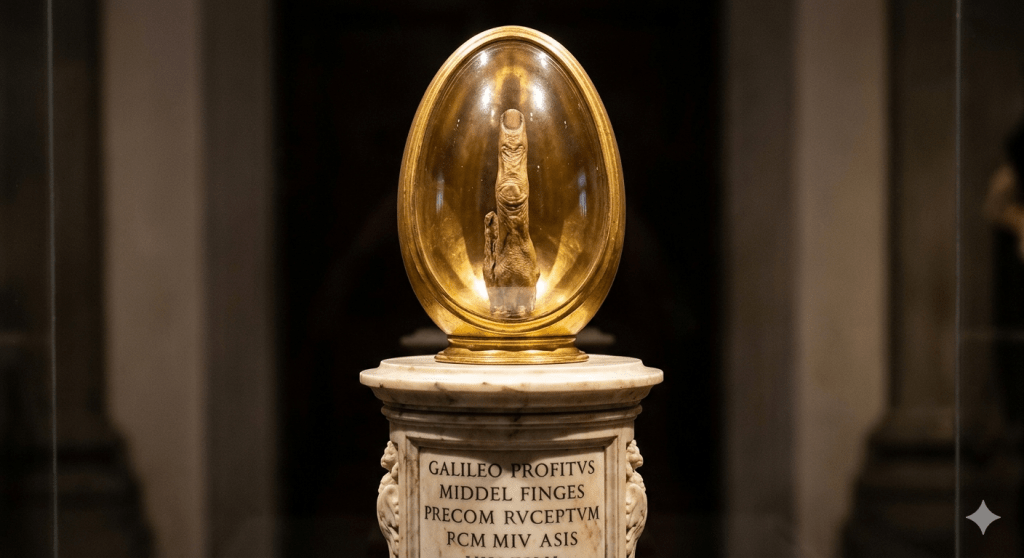
In 1841, the finger was moved to the Tribuna di Galileo at La Specola, a museum of physics and natural history established to celebrate the Tuscan scientific tradition. It was eventually transferred in 1927 to the Institute and Museum of the History of Science, which rebranded as the Museo Galileo in 2010. Today, the finger is encased in a gilded glass egg, standing atop a cylindrical marble pedestal—a display that consciously evokes the aesthetic of a religious monstrance.
The finger is not merely a biological specimen; it is an artifact of “Galilean Iconography”. It sits in a softly lit chamber alongside the only surviving instruments designed and built by Galileo, including the objective lens he used to discover Jupiter’s moons. This placement creates a symbolic dialogue between the observer’s body and the observer’s eye, framing the finger as the physical extension of the mind that reoriented the human understanding of the cosmos.
The Lost Digits: The 2009 Resurrection
While the middle finger remained in public institutions, the thumb, index finger, and tooth—taken by Marquis Vincenzio Capponi—experienced a much more fragmented history. These parts were placed in a handblown glass vessel, which was later encased in a wooden box topped with a bust of Galileo. For generations, the Capponi descendants maintained possession of the reliquary, but the specific identity of the contents was eventually lost to time.
In 1905, the relics disappeared from the historical record, leading scholars to believe they had been destroyed or permanently lost. However, in late 2009, a wooden case matching the description of the Capponi reliquary appeared at an art auction. The auction listing described the lot as “unidentified human remains” in an eighteenth-century vessel. Alberto Bruschi, a renowned Florence art collector, purchased the lot and, upon noticing the bust of Galileo on the exterior, contacted the museum officials.
Verification of the relics involved comparing the physical state of the fingers and tooth with the detailed notary reports from the 1737 exhumation. The identification was confirmed by the Director of the Museo di Storia della Scienza, Paolo Galluzzi, and the Soprintendente al Polo Museale Fiorentino, Cristina Acidini. The reunion of the fingers in 2010 allowed the museum to present a nearly complete set of the “secular relics” that had been scattered for over a century.
Biomechanical Analysis of the 5th Lumbar Vertebra
The fifth lumbar vertebra (L5) took a different path, donated to the University of Padua by Domenico Thiene in 1823. This specific bone has been the subject of intensive medical and anthropological study, as it provides physical evidence of the ailments that plagued Galileo during his later years. Analysis conducted by researchers at the University of Padua’s “Palazzo Bo” utilizes radiographic and Computed Tomography (CT) imaging to diagnose the astronomer’s chronic conditions.
These measurements exclude significant systemic diseases but do document a mild arthrosis characterized by small osteophytes. Historical medical studies suggest that Galileo’s chronic arthritis, which eventually led to his bilateral blindness, was likely a form of reactive arthritis. This condition is hypothesized to have been triggered by a Chlamydia pneumoniae infection contracted in June 1593 after Galileo and his associates slept in the “Wind Room” of the Villa of Count Camillo Trento, which was cooled by air circulated from nearby caves. This “serious ophthalmia” and recurrent arthritis represent the physical toll of his long-term confinement and environmental exposure.
Semiotics of the Gesture: The Digitus Impudicus
The choice of the middle finger as the primary relic for public display is laden with symbolic irony. In antiquity, the middle finger was known as the digitus impudicus—the “impudent” or “indecent” finger. Its primary function was a phallic gesture meant to mock, insult, or ward off evil, essentially the ancient world’s equivalent of “screw you”.
The placement of the finger in the museum appears to point upwards toward the heavens. For the scientifically minded, this represents Galileo’s eternal gaze toward the stars and the divine mathematics he perceived in the cosmos. However, in the context of his persecution by the Inquisition, the finger is frequently interpreted as a posthumous act of defiance. It serves as a permanent “flip” to the Church that once forced him to recant his views and imprisoned him for the remainder of his life.
The Latin inscription on the marble base, composed by the astronomer Tommaso Perelli, provides a poetic justification for the relic’s preservation :
“Leipsana ne spernas digiti quo dextera coeli / Mensa vias nunquam visos mortalibus orbes / Monstravit, parvo fragilis molimine vitri / Ausa prior facinus cui non Titania quondam / Suffecit pubes congestis montibus altis / Nequidquam superas conata ascendere in arces.”
This verse implores the viewer not to despise the remains of the finger that showed humanity the paths of the heavens and planets previously invisible to mortals. It compares Galileo’s feat using “fragile glass” (his telescope) to the failure of the Titans, who attempted to reach the celestial heights by piling mountains upon mountains. The finger thus becomes a metaphor for the power of the human intellect to transcend physical and dogmatic limitations.
It’s always a friendly gesture to help the dead flip off some dickhead that wronged them… PML~


Leave a comment