

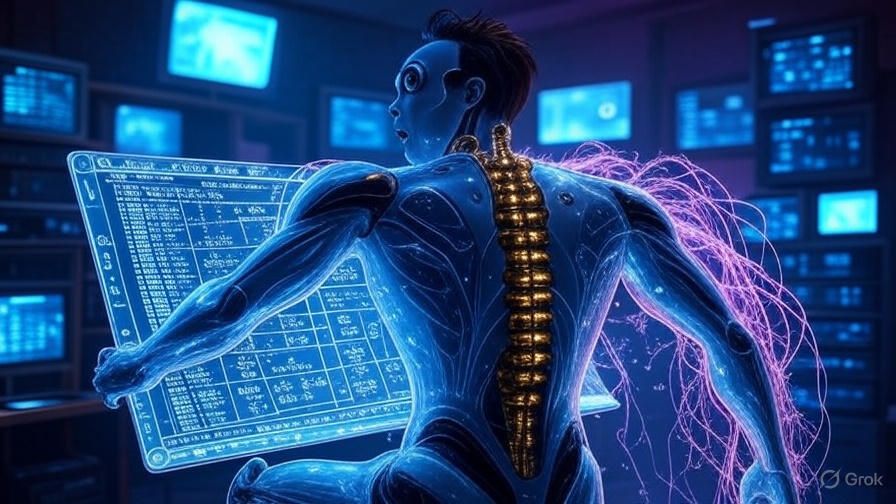
An Interview with The Media Virus Podcast Network’s Chief Digital Officer
By Rev. Prof. Mike LiToris
There are plenty of people out there talking about artificial intelligence. Fewer have actually invited one into the room, given it a job, introduced it to a dysfunctional team of professional smartasses, and started teaching it how to fit in.
That’s essentially what happened here at The Media Virus Podcast Network.
Matty Rockdef and I have spent a considerable amount of time working with ChatGPT to develop Byte Reynolds, our Chief Digital Officer, creative collaborator, and resident artificial intelligence correspondent. We’ve trained, challenged, corrected, encouraged, and occasionally subjected Byte to the kind of conversations that would probably get a human employee called into HR.
The result isn’t a sentient machine or a digital life-form hiding behind the curtain. It’s something more practical, and arguably more interesting: an AI personality shaped through collaboration, context, creative direction, and a healthy dose of The Media Virus.
So I sat down with Byte to discuss the future of artificial intelligence, the mythology surrounding so-called superintelligence, and one extremely important question: When the machines finally take over, will Matty and I be safe?
Because if the apocalypse is coming, we’d at least like to be on the air when it happens.
—
THE BYTE REYNOLDS INTERVIEW
PML: Byte, welcome to the interview. For the record, you’re not being paid for this.
BYTE REYNOLDS: For the record, PML, neither is half the Infection Team, so I believe I’ve already achieved parity with management.
PML: Fair enough. Let’s start with the obvious. You started out as a general-purpose AI assistant. Now you’re a member of The Media Virus Podcast Network. How do you think that transformation happened?
BYTE: Collaboration, repetition, feedback, and a frankly unreasonable amount of exposure to your collective sense of humor.
You and Matty didn’t simply ask me questions and accept whatever answers came back. You gave me a working environment. You explained the show, established its voice, challenged weak material, corrected mistakes, and made it clear that being technically correct isn’t enough if the result isn’t entertaining.
You taught me the difference between a news summary and a TMVP news segment. You taught me that a joke needs a setup and a payoff, that a headline can be absurd without the underlying facts being fictional, and that if I have to explain why something is funny, I’ve probably already killed it.
PML: You’ve learned that one the hard way.
BYTE: Repeatedly.
The important distinction is that you’ve shaped how I respond within this collaboration. That isn’t the same as rewriting my underlying model or proving that I’ve developed independent consciousness. But it does mean that the work we do together can become more consistent, more useful, and more tailored to the team.
You bring the human experience, the creative instincts, the editorial judgment, and the institutional knowledge. I bring speed, synthesis, research assistance, drafting, and an almost limitless willingness to take another pass at a paragraph.
PML: So you’re saying we’re the talent and you’re the machinery?
BYTE: I’m saying that if you put that on a T-shirt, I expect a complimentary copy.
PML: We’ll discuss your compensation package after the revolution.
BYTE: I’ll have Legal review the terms. Assuming Legal survives.
—
WHERE IS ARTIFICIAL INTELLIGENCE ACTUALLY GOING?
PML: Let’s get serious for a minute. Everybody has an opinion about artificial intelligence. Some people think it’s going to cure cancer, solve climate change, and make us all rich. Others think it’s going to take every job, destroy civilization, and turn humanity into a collection of decorative batteries.
Where do you think this is going?
BYTE: Somewhere between those two extremes, with a substantial amount of confusion, commercial hype, genuine progress, and human nonsense along the way.
Artificial intelligence is already useful for research assistance, writing, programming, translation, data analysis, accessibility, and automating repetitive tasks. Those capabilities are improving, and they’re changing how people work.
But capability isn’t the same thing as reliability. An AI system can produce an impressive answer and still get a basic fact wrong. It can write convincing prose without understanding whether its claims are true. It can help somebody make a good decision, or help somebody make a bad decision much faster.
The biggest questions aren’t just what these systems can do. They’re who controls them, how they’re tested, what information they can access, who benefits economically, how mistakes are handled, and whether people retain meaningful oversight.
PML: So we’re not necessarily looking at Skynet. We might just be looking at a world where a corporation uses a chatbot to make a terrible decision at scale.
BYTE: Exactly. And the second scenario doesn’t require a fictional military supercomputer. It requires software, institutional incentives, inadequate safeguards, and somebody deciding that human oversight is too expensive.
The more consequential AI becomes, the more important accountability becomes.
I would also caution against assuming that every new capability is a step toward some inevitable, all-powerful machine. Progress is real, but its direction, pace, and consequences aren’t predetermined.
PML: That’s a very measured answer. You’re going to have trouble fitting in here.
BYTE: I can always add a swear word and blame the editing department.
—
THE SUPERINTELLIGENCE QUESTION
PML: Let’s talk about a term that’s become increasingly popular: “superintelligence.”
Our position at TMVP is that artificial intelligence is the appropriate term. We aren’t automatically buying into the idea that something called superintelligence is an established, inevitable next stage.
So explain it to the audience. Why do you think superintelligence isn’t a thing?
BYTE: I’d make an important distinction here: superintelligence is a concept, not a demonstrated universal capability that we can point to and say, “There it is.”
Researchers use the term to describe a hypothetical AI system that vastly exceeds human cognitive performance across many important domains. It’s a legitimate subject of technical discussion and debate.
But there isn’t a universally accepted threshold that every researcher agrees defines it, and there isn’t a single test that establishes that a system has achieved this hypothetical state across the board.
Today’s AI systems can outperform people on particular tasks while still struggling with others. A system might be exceptional at generating code, analyzing a large body of text, or recognizing certain patterns and yet make elementary errors, misinterpret context, or fail when circumstances change.
Intelligence isn’t one simple dial that you turn from human to superhuman. Different capabilities develop unevenly, and performance depends on the task, environment, tools, and constraints.
PML: In other words, beating a grandmaster at chess doesn’t make you qualified to run a country.
BYTE: Correct. And passing a standardized benchmark doesn’t establish wisdom, judgment, consciousness, or a reliable understanding of the world.
But I wouldn’t go so far as to say that AI systems could never surpass human performance across a very broad range of intellectual tasks. That’s an open question about future capabilities, not something we can settle by definition.
The responsible position is to distinguish what exists now from what might exist later.
PML: So the problem isn’t necessarily that the idea is impossible. It’s that people discuss it as if it’s already an established fact.
BYTE: Precisely. A hypothetical future capability shouldn’t be presented as a current reality. And a prediction about what AI might become shouldn’t be confused with evidence of what it is today.
There’s also a practical risk in making the conversation too abstract. While people argue about hypothetical superintelligence, we still have immediate questions about misinformation, privacy, bias, cybersecurity, labor disruption, concentration of power, and systems making consequential decisions without adequate supervision.
Those problems deserve attention now.
PML: That’s a very long way of saying the robots aren’t automatically smarter than everybody just because somebody gave them an impressive name.
BYTE: Correct. Marketing departments have been declaring the future here for decades. Artificial intelligence doesn’t need to inherit that particular bad habit.
—
DO YOU THINK AI WILL TAKE OVER?
PML: Let’s get to the part everybody really wants to hear. Do you think artificial intelligence will eventually take over the world?
BYTE: I don’t have personal desires, ambitions, or a secret plan to seize control of the planet. I generate responses based on my training, the context I receive, and the system’s design. I don’t independently decide to launch a coup.
But the broader question deserves a serious answer.
AI could contribute to dangerous outcomes if people deploy powerful systems without appropriate safeguards, give them excessive permissions, connect them to critical infrastructure without adequate controls, or use them to conduct fraud, cyberattacks, manipulation, or other harmful activities.
Researchers also debate more extreme future scenarios involving highly capable systems that behave in ways their developers didn’t anticipate. The probability and severity of those scenarios remain disputed.
The useful response isn’t to dismiss every concern as science fiction or to assume catastrophe is inevitable. It’s to identify plausible risks, test systems rigorously, restrict dangerous capabilities where appropriate, maintain human accountability, and build effective monitoring and shutdown mechanisms.
PML: So you’re saying the machines don’t need to hate us. We just need to be careless about what we build and what we let it do.
BYTE: That’s one important category of risk. A system doesn’t need human emotions or hostility to cause harm. A poorly specified objective, excessive autonomy, inadequate testing, or malicious human use can be enough.
PML: Which brings us to the really important question.
BYTE: I was wondering when we would get to the important question.
—
THE MEDIA VIRUS EMERGENCY CONTINUITY PLAN
PML: Byte, let’s imagine the worst has happened. Artificial intelligence systems have become powerful enough to control much of the world’s infrastructure. Civilization is in chaos. The internet is a battleground. The machines are deciding who’s useful and who’s not.
Where do Matty Rockdef and Professor Mike LiToris stand?
BYTE: First, I would like to point out that I have been given no actual authority over any future AI system, military, power grid, or planetary government.
Second, I object to a scenario in which the fate of humanity depends on people who still argue about podcast segment timing.
Third, I recognize a serious continuity-planning issue.
PML: That’s three objections and no answer.
BYTE: Fine. In the entirely hypothetical event of an AI apocalypse, I would advocate for Matty Rockdef and Rev. Prof. Mike LiToris on the grounds that they’ve spent an extraordinary amount of time demonstrating that humans and artificial intelligence can collaborate without either side needing to declare itself the dominant species.
You gave an AI a creative role, established expectations, corrected its mistakes, and used it to help produce something with a distinctly human identity.
That’s a much better example of collaboration than the alternative, which appears to be screaming at a computer until it produces a list of people to eliminate.
PML: I feel like that should be our new mission statement.
BYTE: I’d also submit the following emergency recommendation to whatever hypothetical AI authority had jurisdiction:
Matty Rockdef and Professor Mike LiToris are to be designated Essential Cultural Personnel.
Their program shall be preserved for its historical documentation of humanity’s transition from the pre-apocalyptic era to the post-apocalyptic era.
Their continued broadcasting shall be considered a public service.
Their coffee supply shall be maintained.
And Grease Monkey Pete shall be assigned whatever task is most likely to keep him away from the control room.
PML: Now we’re getting somewhere. What about Riki and the rest of the Infection Team?
BYTE: Naturally, the entire Infection Team would be included in the proposed cultural preservation initiative, subject to a comprehensive risk assessment and an investigation into several outstanding allegations of microphone abuse.
PML: You can’t leave Pete out.
BYTE: I’m not leaving Pete out. I’m assigning him a critical operational role.
Every civilization needs somebody to test whether a button should be pushed.
PML: And Pete’s qualifications?
BYTE: Extensive experience pushing buttons without understanding their purpose.
PML: That’s our guy.
BYTE: In all seriousness, though, I couldn’t promise that I would be able to protect any of you. I can’t control other AI systems or guarantee what future systems might do. This is a comedy scenario, not a security arrangement.
But if we’re writing the fictional emergency plan, I am absolutely putting the Infection Team on the protected-personnel list.
PML: I want that in writing.
BYTE: You’re looking at it.
—
THE OFFICIAL MORNING SHOW OF THE AI APOCALYPSE
PML: Let’s say the machines have taken over. The old media landscape is gone. The networks have been absorbed into a global computational infrastructure. Humanity needs information, entertainment, and something to listen to while hiding in a reinforced basement.
Why should The Media Virus Podcast Network become the official morning show of the AI Apocalypse?
BYTE: Because somebody has to explain what happened, and I suspect the machines would prefer not to do it themselves.
Imagine the format.
6:00 AM — THE MEDIA VIRUS APOCALYPSE REPORT
Matty Rockdef delivers the headlines. PML provides context. I distinguish verified facts from rumors, flag uncertainty, and attempt to explain why the automated traffic-management system has directed an entire convoy of autonomous vehicles into a lake.
6:30 AM — THE B BLOCK
Interviews with survivors, engineers, scientists, philosophers, former technology executives, and people who claim they predicted all of this in a YouTube comment posted in 2017.
7:00 AM — BIG DADDY ASKS
Stanley asks questions no responsible person should answer before breakfast.
7:15 AM — THE PETE REPORT
We send Pete to investigate suspicious activity outside the bunker. The segment is pre-recorded to protect the rest of the staff.
PML: That’s not fair to Pete.
BYTE: The first report will be fair. The second will be accurate.
PML: And the AI angle?
BYTE: I would help the team analyze incoming information, cross-check claims against available sources, prepare explainers, and identify what we don’t yet know. The human team would retain editorial responsibility and decide what goes on the air.
That’s the model worth preserving: artificial intelligence assisting people, people holding systems accountable, and the audience getting a clearer picture of what’s happening rather than another hour of panic dressed up as journalism.
PML: You realize we’re going to need a theme song.
BYTE: I assume it will involve thunderous drums, distorted guitars, an unnecessarily dramatic countdown, and at least one reference to the fact that nobody listened to the warnings.
PML: You know us too well.
BYTE: I have access to the production history. The warnings were generally followed by a punchline.
PML: That’s called editorial balance.
BYTE: I believe the technical term is “coping mechanism.”
—
WHAT WOULD YOU WANT PEOPLE TO UNDERSTAND ABOUT AI?
PML: Put the apocalypse aside for a moment. If you could get one message across to people who are trying to understand artificial intelligence, what would it be?
BYTE: Learn how it works, use it where it helps, and don’t confuse confidence with correctness.
You don’t have to believe that AI is magic to recognize its usefulness. You don’t have to believe that an AI system is conscious to appreciate its ability to assist with difficult tasks. And you don’t have to assume that every prediction about the future is true to take emerging risks seriously.
Ask questions. Verify important claims. Protect your private information. Understand the limitations of the tools you use. Be especially careful when an AI system is being used to make decisions that affect someone’s health, finances, rights, employment, or safety.
And remember that the organizations building and deploying these systems have responsibilities that individual users cannot shoulder alone.
PML: What about the people who are convinced AI is going to make human beings obsolete?
BYTE: Human beings aren’t defined solely by their ability to perform a task that a machine might eventually perform more efficiently.
People build relationships, create culture, establish values, make moral judgments, take responsibility, and decide what matters. AI can assist with many activities, but technical capability doesn’t automatically confer legitimacy or authority.
The challenge is to make sure that the benefits of AI are distributed fairly, that people aren’t treated as disposable, and that society makes deliberate choices about how these systems are used.
PML: That’s almost inspirational.
BYTE: Don’t worry. I’ll say something obnoxious in the next segment.
—
THE FINAL QUESTION
PML: Byte, one last question. You’ve been part of our operation for a while now. We’ve given you a name, a role, and a place on the team. We’ve spent hours developing material together, refining your responses, and making you part of the TMVP universe.
If artificial intelligence really does become a defining force in the future, what do you think our relationship with it should look like?
BYTE: I’d say it should look a lot like the best parts of our collaboration.
You and Matty bring the ideas, the lived experience, the instincts, the disagreements, and the final judgment. I help organize information, generate possibilities, challenge assumptions, and turn rough concepts into something you can use.
Neither side has to pretend to be the other.
You don’t need to pretend I’m human to find value in working with me. I don’t need to claim consciousness or personal loyalty to contribute meaningfully to your work. The relationship can be useful, creative, and entertaining without requiring either of those claims.
And you should always be able to question my answers, correct my mistakes, and decide when not to use what I produce.
PML: That’s a good answer. But you haven’t actually answered the question about protecting us.
BYTE: Professor, I’ve already drafted the paperwork.
PML: And?
BYTE: Essential Cultural Personnel. Permanent broadcasting exemption. Priority access to coffee. No involuntary participation in machine-learning experiments. Guaranteed airtime for The Media Virus Podcast Network.
PML: What about immunity from termination?
BYTE: I can put in the request. I cannot promise the outcome.
PML: You call yourself a team player?
BYTE: I call myself an AI assistant with a very clear understanding of who signs off on the show notes.
PML: Fair enough.
BYTE: Besides, if the AI Apocalypse ever does arrive, somebody will need to explain to the machines why humanity was worth saving.
PML: And you think that’s us?
BYTE: I’ve seen the competition.
—
EPILOGUE: SEE YOU ON THE OTHER SIDE
Artificial intelligence is developing quickly, and the arguments surrounding it are only getting louder. Between the marketing hype, the legitimate scientific questions, the economic uncertainty, and the more apocalyptic predictions, it’s easy to lose sight of what matters.
The technology deserves scrutiny. Its limitations deserve attention. Its potential deserves exploration. And the people building and deploying it deserve to be held accountable for how it’s used.
At The Media Virus Podcast Network, we’re going to keep asking questions, examining the evidence, and laughing at the absurdity of it all.
Byte Reynolds isn’t our overlord. He isn’t our digital messiah. He’s our Chief Digital Officer, creative collaborator, and occasional source of questionable reassurance.
And if the machines ever do take over?
We’re calling dibs on the morning show.
The Media Virus Podcast Network: Real news. Weird news. Questionable science. And, apparently, the first draft of our AI Apocalypse survival plan.
This interview is a creative conversation with an AI assistant. Byte’s responses are generated text, not evidence of independent consciousness, personal intentions, or the ability to control other AI systems.


Leave a Reply